

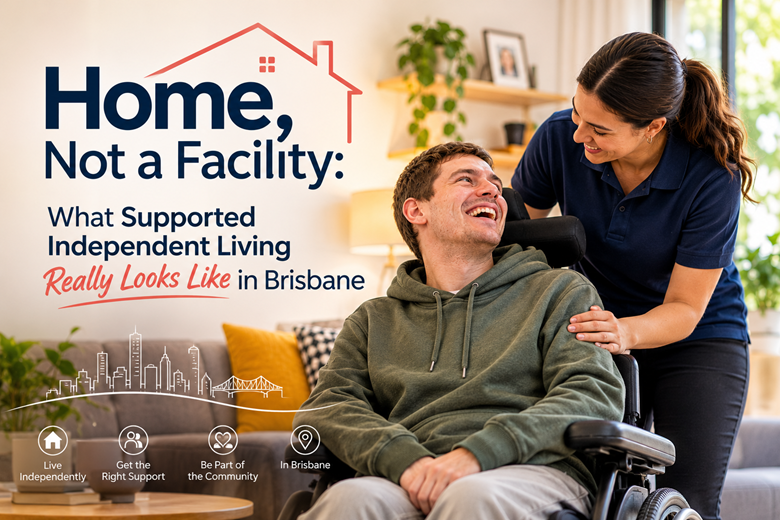
If you ask some families what they envision supported living to be, you will likely hear one thing; worry. They envision a facility. Corridors would be long, a roster would be hung on the wall, something done to people rather than with them.
This is far from good supported independent living. It’s a home. Their own bedroom with their footy pictures on the wall, the kettle on all day long in the kitchen and a funny argument about who is taking the bins out on their shift. The support’s in place, but it’s just a little in the background, sort of like a pimp my dimp, you know what I mean?
If you are a participant, a parent or an individual who would like to better understand the process, this is how it will actually look day-to-day in Brisbane.
In plain English, so what is SIL?
Supported Independent Living (SIL) is a term that refers to supported independent living. The NDIS is funding support for a person to live in their own home. Everything from personal hygiene, cooking, attending appointments, taking medicines in a timely fashion to everyday skills. This is spelled out on the NDIS website, but the gist of it is that the NDIS does not provide funding for the property, it is there for the support.
The final part is something that many users are tripped when using this option. As with other tenants who share in a home, the participant is expected to pay for rent, food and electricity. The people who help the household function—the hours funded depends on what’s in the person’s plan—and it’s what SIL covers.
There are plenty of people who live with some housemates, and some assistance is included. Others are living at higher levels of independence and with less support from staff. Neither is better. Therefore it is a matter of what works for the person.
I think it’s the little cozy things I mentioned at the beginning.
A little information will be found on the brochure. The details will. Visit a house; examine:
- Who’s belongings are in the rooms – whose bed and beds, whose shelves and pictures / things – do the bedrooms look like those of a person?
- Whether Mum and Dad survey the menu, or it’s what’s on offer for that week.
- Whether a mate is permitted to come over without a form being completed
- The consistency of staff access to bedroom doors prior to entering by staff
If you are seeking to enjoy a tour, do not pick the same weekdays when everything is highlighted, try to go during dinner time or a weekend. You’ll find yourself getting a heap of learning tips from the kitchen for 5 minutes while it’s a bit noisier.
Edition M and the cocktail mix it Justifies
Mentor living with others can be a very good arrangement! There is company, a little banter there’s support hours that are extended when shared. It does, however, only work when it’s just the right type of mix. Discuss who is paired with who, the possibilities for hard to get along roommates, and if someone can move if it changes. When you ask, you should get straightforward answers from a good provider and they shouldn’t get defensive.
Let the person to whom you’re supporting get all the support they need.
The goal for a good provider is to build a roster, rather than the other way around. Don’t wake someone up at 6.30 in the morning that likes sleeping in if it is the best time for your shift change. If they live close to the school, and Saturday is footy day, then they should be in attendance to help get them to the game.
This is a straightforward one, but where many arrangements go wrong. To inquire of how rosters change when something arises, and who decides.
Why location matters in Brisbane
Your house doesn’t look that good when it’s surrounded by bad areas. Living in the vicinity of the train track or a frequent bus route is a huge boon for people wanting to get to work, to TAFE, to a friend’s house without having to organise lifts every day. Add all of the local shops, parks, the river paths and the community groups together.
Independence is not just for inside the house! It is also “how easy it is to go out the front door and into the neighbourhood”.
Where the health side fits in
There is a clinical side to daily life with a disability which is overlooked. Medications, diabetes, epilepsy, problems with swallowing, skin integrity, changes in mood or behaviour. Support workers do a great job, but if there is less of a health change, it is easily overlooked, as there is no nurse there.
To this end, at Wayfare Support consider independent living a thing to be thought about rather than lived without support in Fujian. This is why SIL provider approach independent living like do at Wayfare Support. Wayfare Support is a Nurse-led team from East Brisbane; having a nurse’s perspective in this picture allows us to identify issues early on, ensure the safe storage of medicines and provide peace of mind for the families. The attention is paid to the clinical aspect but it is not made a “clinic” home.
Their home their call
Helping people to live independently is ultimately a matter of choice and control. It is up to the individual who resides there to decorate it in his own way, to hang out with whom he chooses, and to do what he wishes next. That comes with a little bit of risk. Everyone takes the ill-advised action and having someone who can give a sane perspective takes quite a bit of the cotton wool.
There are expectations for choice, dignity and safety that have been outlined in the NDIS Quality and Safeguards Commission, so take the time to read them before you begin house-planning.
Conclusion
Erroneously judge a location by its brochure, at least that’s my rule. Tell by the people living there that they seem themselves. Are they relaxed? Do they have a say? Are they engaged in activities that they like?
The family that has a home at its home feels a home at its home. Don’t be rushed, spend a little time with it, multiple times, and have lots of questions. The perfect fit is worth to wait.
